The Graham Weekly Album Review #1455
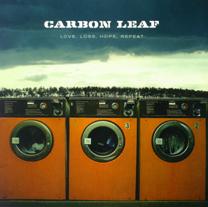
Click on CD Cover for Audio Review in Real Audio format | |
by George Graham
(Vanguard 79799 As broadcast on WVIA-FM 8/30/2006)
| Click on CD Cover for Audio Review in Real Audio format | |
(Vanguard 79799 As broadcast on WVIA-FM 8/30/2006)
Given the current state of the commercial music industry, the concept of thoughtful, intelligent rock might seem like something of an oxymoron. But as this program tries to do every day, if one looks beyond what is found on the media conglomerates, one can find a great deal of worthwhile music that might even sound vaguely mainstream.
This week we have an excellent example -- a band who bring the literate lyrics of a singer-songwriter with a tasteful combination of rock and acoustic instrumentation. It's the latest recording by the Richmond, Virginia-based band Carbon Leaf, called Love, Loss, Hope, Repeat, and it's their seventh release.
Carbon Leaf began when singer and songwriter Barry Privett and guitarist Terry Clark were both students at Randolph-Macon College. Guitarist Carter Grevatt and drummer Scott Milstead started jamming with Clark, and Privett joined as a vocalist in 1992. The band broke up for a while after the members graduated from college and landed non-musical jobs. But they re-formed in the mid 1990s, with the members sharing a house in Richmond. They started attracting attention and releasing independent CDs, which further enhanced their reputation, with their winning a national talent competition. In 2004, the band with Jordan Medas on bass, released Indian Summer, after being signed to the venerable Vanguard label. They toured extensively, opening for the Dave Matthews Band, John Mayer and others. Indian Summer was, for most people who had not gotten to hear the band's independent recordings, a very impressive debut of a band that combines elements of roots rock with even hints of art rock held together with intelligent lyrics and classy vocals.
Now, two years later, they are out with Love, Loss, Hope, Repeat, and the group seems to have narrowed their sound a bit, but the material remains first rate, with perhaps even better lyrics this time around. Barry Privett again writes all the words, while the rest of the band composes the music. For the project, they brought in producer Peter Collins, who has worked with artists ranging from Bon Jovi to the Indigo Girls. Previtt, who writes all the lyrics, says that the songs came together rather quickly, mainly in the studio, with producer Collins doing some editing of the ideas. The album's title comes from one of its songs, and Previtt said that it reflects the melancholy tone of much of the CD. There are the expected contingent of love songs, but also a couple of traveling songs as well as an examination of the images of war.
Leading off is one the band's lyrically intriguing love songs, Learn to Fly. The track reflects the band's distinctive sound with their folky undercurrent, and the 12-string electric guitar hinting at that epitome of folk-rock bands The Byrds. <<>>
The CD's title track, Love, Loss, Hope, Repeat, has an occasionally vaguely funky beat, to accompany the interesting lyrics about an interrupted affair. <<>>
Royal One, is one of the more lyrically intriguing pieces on this album of worthy wordcraft, while the band frames the tune in an almost march-like rhythm. <<>>
One of the rockier tunes is A Girl and Her Horse, which uses the equestrian setting as a metaphor for love galloping away. But musically, it's not the band's most interesting piece. <<>>
There is probably a story behind the song Texas Stars, and its allegorical lyrics. As it is, its one of the album's stronger tracks musically. <<>>
Also in the category of complicated love songs is Comfort, which with its various musical changes of texture hints at art rock, something that the band has done on their last album. <<>>
The recording's most memorable track is The War Was in Color, which takes the form of a dialogue between a grandson and a grandfather presumably about World War II. Toward the end of the song, it turns out that the grandfather was present only in spirit. <<>>
The CD ends with another traveling song, and one of the album's more upbeat and melodic tracks International Airport, which also sums up this band's strengths. <<>>
Love, Loss, Hope, Repeat, the new CD from Virginia-based Carbon Leaf is another worthy album from a quintet that combines the lyrical sensibility of a singer-songwriter with the musical appeal of a sophisticated rock band to create music that can be enjoyed on a number of levels. There are elements of folk-rock as well as more contemporary influences; the band vocals and their harmonies are both strong and rather distinctive. Their new material is some of the best that this band had done,
For our sonic grade, we'll give the CD about an A-minus. There is fairly good clarity, and their combination of acoustic and electric instruments are captured well. The dynamic range, the way the recording handles loud and soft moments, is a somewhat better than the contemporary average for a rock band.
For over a decade, Carbon Leaf has been making worthwhile, intelligent, classy rock , and gradually gaining wider recognition. Love, Loss, Hope, Repeat, their eighth album, is probably their best yet, and should hopefully attract even more fans to this deserving band.
(c) Copyright 2006 George D. Graham. All rights reseved.
This review may not be copied to another Web site without written permission.
Comments to George: 
 To Index of Album Reviews | To George Graham's Home Page. | What's New on This Site.